
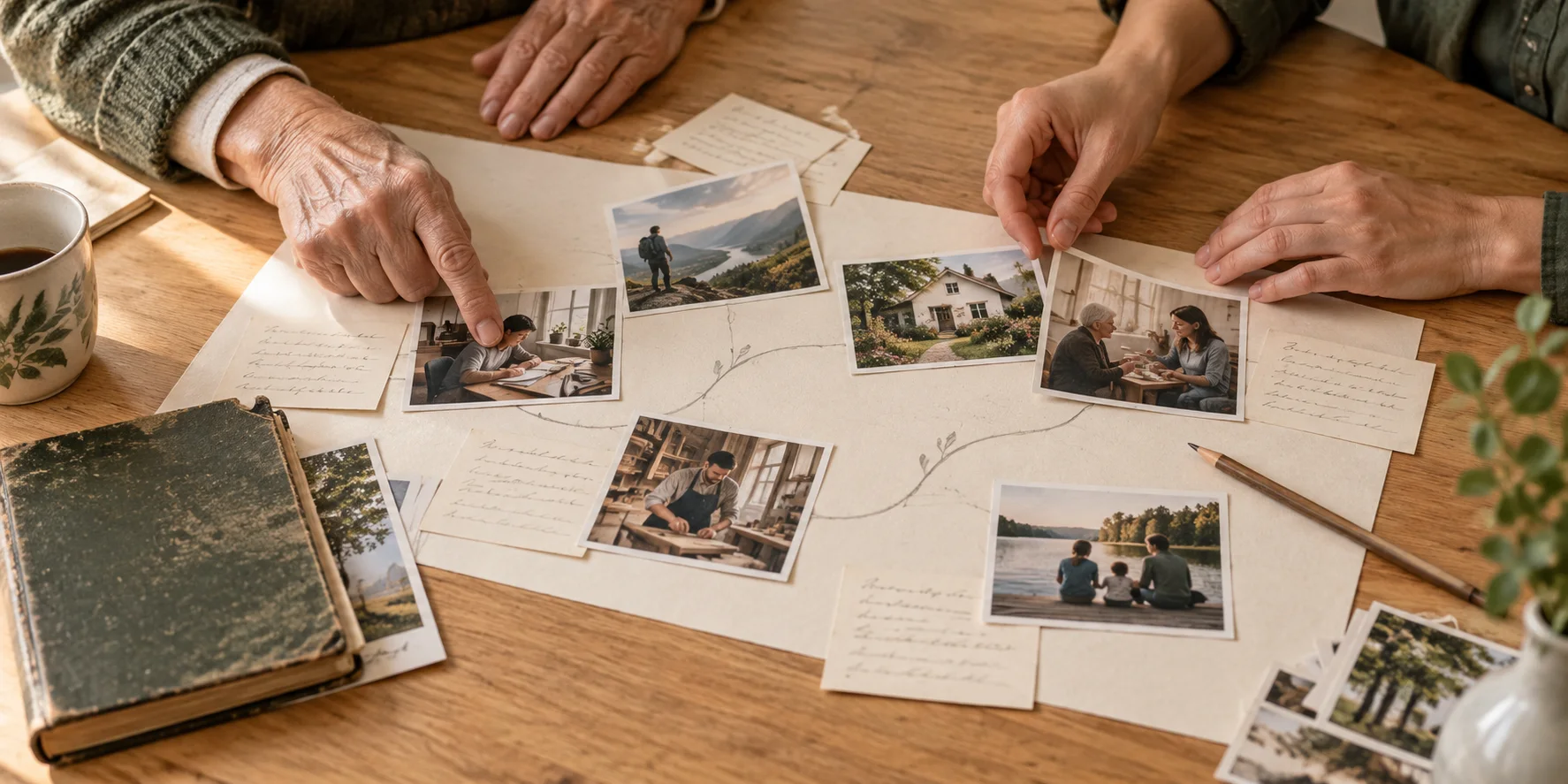
A person can spend much of their life continually responding to circumstances. Getting an education, finding work, providing for a family, meeting obligations, living through another round of change, and adapting once again. Each action has an immediate reason; every day is filled with necessary tasks. Yet the overall meaning of what is happening may remain unclear even to the person themselves. They remember how much effort they have invested, but struggle to see their own path as a whole: why certain decisions were made, what those decisions changed, and what kept everything going.
This uncertainty becomes particularly acute when external sources of stability grow unreliable. Work ceases to provide a sense of security, savings become vulnerable, and familiar rules change. A person has to defend once again what their labour has already built. Their time is spent preserving what has been achieved, while the opportunity to pause and make sense of events is postponed until a calmer period. That period may never arrive if it is treated as a necessary condition for a conversation with one's own life.
Social instability has a human cost. Behind political decisions, economic indicators, and shifts in government priorities stand specific years of other people's lives. When power serves personal interests, the preservation of influence, or short-term gain, the consequences must be lived by people who did not make those decisions. For them, a failure of governance may mean a lost job, a closed business, postponed treatment, separation from loved ones, or the need to start again. Public decisions should be judged, among other things, by how responsibly they treat human time.
Public discussion can nevertheless pass the person themselves by. Their circumstances are described through income, employment, property, debt, and purchasing power. These measures matter: a person needs housing, safety, and a livelihood. Yet even an accurate account of material circumstances leaves much of a life unexamined. It does not show what a person has learned, whom they have supported, what they have given up, what responsibility they have accepted, or which consequences of their actions they have come to understand.
The material results of a life may change or disappear. A business may close, property may change hands, and savings may lose their former significance. Such losses require public attention and practical responses. At the same time, a person faces a question about the meaning of the life already lived: how can an understanding of what was done be preserved when the familiar evidence of its results no longer exists?
The answer begins with recognising that one's own story deserves attention.
A life path contains efforts that may have gone unnoticed, decisions whose meaning became clear years later, and mistakes that changed subsequent behaviour. It includes other people's involvement, circumstances that restricted choice, and opportunities a person took or was unable to take. Considered together, these events reveal more than a sequence of successes and failures. The connection between intention, action, and consequence gradually becomes discernible.
This is one of the starting ideas of HUMAS System: participation helps a person make their life path more understandable. It gives them a reason to return to their own experience, name significant events, identify their contribution, and consider decisions in relation to one another. Understanding develops through this work. It requires attention to what actually happened, including uncomfortable episodes, doubts, and changes of view.
Declaring one's path entails responsibility for what is recounted. A memory may be incomplete, a personal assessment may change, and an initial explanation of an action may prove insufficient. The distinctions between an event, its confirmation, and the meaning a person assigns to it therefore matter. An honest story leaves room for clarification. It can acknowledge that, at the time, a person did not know something, was mistaken about something else, or later recognised consequences they had previously overlooked.
Such a story can also matter to heirs. Property conveys an outcome, but often leaves the path that produced it unknown. The next generation may receive a home, documents, photographs, and fragments of family recollection while retaining only a faint understanding of the person who created it all. Why did they choose a particular occupation? What did they consider their duty? Which decisions helped them, and which proved costly? What would they wish to explain to those who will live after them?
Passing on experience that has been thoughtfully examined allows heirs to encounter a person in the complexity of their life. They receive material for their own understanding: they can see how decisions related to circumstances, assess actions, notice recurring mistakes, and draw their own conclusions. Respect for predecessors allows subsequent generations their independence. A story gains value through the possibility of understanding and discussing it.
HUMAS System addresses a person's willingness to think about their own participation in the world. This willingness is available to people of different educational backgrounds, means, and social positions. It begins with the desire to look carefully at what has been done and accept responsibility for one's own account. Everyday work, care for loved ones, unnoticed help, and attempts to repair harm all deserve a place in this work. The significance of a life path emerges through the substance of what has been lived.
This requires a space in which people determine for themselves how open their stories should be. Reflection requires the freedom to choose what to keep private, what to share with loved ones, and what to make available to others. Respect for a personal path includes respect for its boundaries. Openness is meaningful when it remains a conscious decision.
This work can begin with one event that still seems significant. Reconstruct the circumstances, recall your intentions, name the decision you made, and consider its consequences. Then turn to another episode and see the connection between them. These connections gradually form a more understandable picture of your own participation in life.
We can spend a long time building, acquiring, and protecting what we have achieved while leaving unexamined the question of who we are becoming in the process. Returning to our own story brings this question into the present. It allows us to attend more carefully to the life already lived and to define our further direction more clearly.
At the heart of participation in HUMAS System lies precisely this possibility: to make one's path more understandable to oneself and preserve its meaning for those to whom one chooses to pass it on.