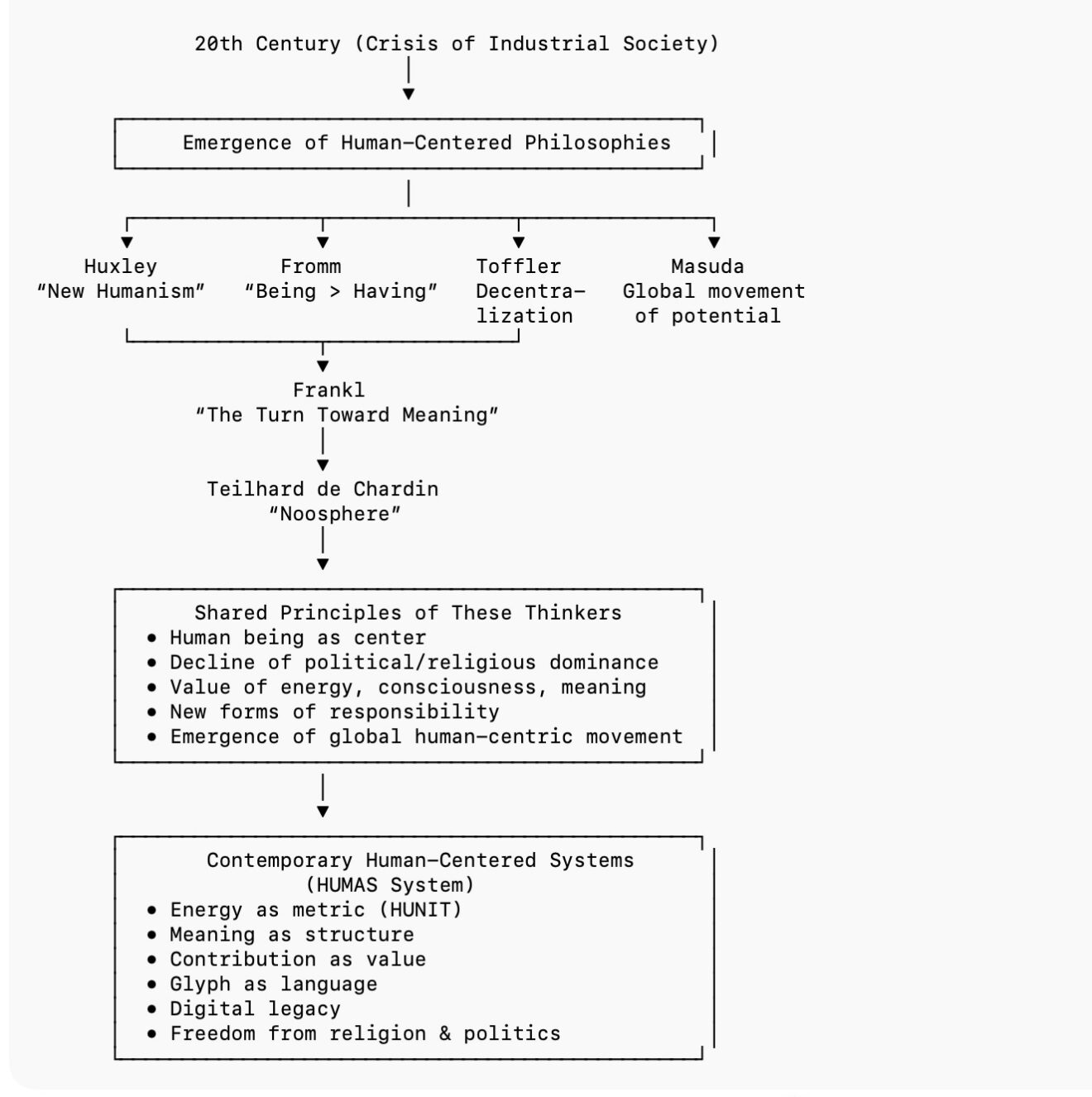
In the late 20th century, several philosophers, futurists, and social thinkers articulated concepts anticipating the emergence of a human-centric model of society in the 21st century — one in which human energy, consciousness, and personal responsibility form the basis of social structures. This article examines key ideas formulated by these authors and evaluates them as intellectual antecedents to contemporary human-centered systems. The analysis shows that, although many thinkers discussed the future role of the human being, none developed a complete framework, mechanism, or operational architecture. Nevertheless, their work created a theoretical foundation for the development of such systems today.
The latter half of the 20th century was marked by the crisis of industrial civilization, the decline of ideological systems, and the weakening of traditional religious institutions. Within this context, a series of philosophical and futurist forecasts appeared, suggesting that the 21st century could bring forth a new type of global movement — one centered on the human being, individual consciousness, energy, and self-determination.
At the time, these ideas were perceived as speculative or visionary. Today, in an era defined by digitalization, societal fragmentation, and accelerating technological change, they acquire renewed significance. This article analyzes these concepts as the intellectual background for the emergence of contemporary human-centered models.
1. Aldous Huxley’s Late Humanism
In his later works, Aldous Huxley formulated the idea of a “new humanism” meant to arise after the age of ideology. Observing the decline of traditional institutions, he wrote:
“The twenty-first century will be either the century of a new humanism, or the century of destruction.”
Huxley anticipated:
• a shift from external religiosity to personal spirituality;
• weakening of political structures;
• increased personal responsibility;
• a search for value within human consciousness itself.
While Huxley did not propose a concrete system, he set the direction toward placing the individual at the center.
2. Erich Fromm and the Concept of a “Humanistic Civilization”
Fromm examined industrial capitalism through the lens of alienation and the loss of meaning. He argued that humanity would eventually face a choice: transition
• from having to being;
• from external structures to internal maturity;
• from social conformity to autonomy.
Fromm predicted the emergence of a humanistic civilization, where meaning, freedom, and responsibility replace institutional power.
3. Alvin Toffler and the Post-Industrial Human Being
In The Third Wave, Toffler articulated the model of a transition from industrial to post-industrial civilization. He predicted:
• the collapse of party-based political systems;
• the decline of centralized forms of power;
• the rise of autonomous micro-communities;
• the increasing value of knowledge, attention, and time;
• the need for new metrics of human contribution.
Toffler’s work outlines the cultural and technological soil from which human-centric systems could later emerge.
4. Yoneji Masuda and Japanese Futurism
Masuda’s work from the early 1980s is among the most structurally aligned with modern human-centric concepts. He predicted the development of:
• a global movement based on human potential;
• societies with diminished influence of religion and political parties;
• systems where contribution and responsibility outweigh social status;
• distributed networks centered on the individual.
His concept of the “information society as a new humanism” closely parallels today’s human-centered paradigms.
5. Viktor Frankl: The “Turn Toward Meaning”
Frankl argued that post-industrial society would face an “existential vacuum,” creating demand for:
• movements centered on meaning;
• new forms of personal spirituality without institutions;
• increased individual responsibility;
• existential autonomy outside ideology.
Frankl viewed meaning as a structural principle capable of replacing religious and political dominance.
6. Pierre Teilhard de Chardin and the Project of the Noosphere
Teilhard de Chardin proposed the concept of the noosphere — a global layer of human thought and energy uniting humanity beyond material structures and political divisions. He anticipated:
• intensified interaction on the level of consciousness;
• a new stage of human evolution;
• the emergence of an integrated mental-energetic structure.
In his work appears one of the earliest visions of a unified “field of human energy.”
Shared themes among the precursors
Despite differences in method and focus, these thinkers converge on several critical ideas:
1. Decline of religious and political institutions as primary sources of meaning.
2. The rise of the individual as the main unit of future civilization.
3. The need for new metrics of human contribution — knowledge, attention, energy.
4. The prediction of a global human-centered movement in the 21st century.
5. The shift toward meaning as a structuring principle.
None of these authors proposed:
• a technological mechanism,
• an operational system,
• a measurable energy-based model,
• or a unified framework.
However, their ideas formed a coherent intellectual foundation for such developments.
Philosophical and futurist concepts of the 20th century demonstrate a consistent tendency toward envisioning a new human-centered societal structure. These ideas pointed in the right direction, but lacked systems, architecture, and practical embodiment. HUMAS System can be seen as a contemporary example of such an embodiment — integrating philosophy, technology, responsibility, and human energy into a unified structure.
This article represents an initial step toward the systematic study of human-centered precursors. Further research may expand the comparative analysis and incorporate additional intellectual traditions that shaped these ideas.
Bibliography and Sources
Below are the key works referenced in this philosophical–historical overview.
Aldous Huxley
1. Huxley, Aldous. Human Relations and Human Values. (1958)
2. Huxley, Aldous. The Politics of Ecology. (1963)
3. Huxley, Aldous. Brave New World Revisited. (1958)
Erich Fromm
4. Fromm, Erich. To Have or To Be? (1976)
5. Fromm, Erich. The Sane Society. (1955)
6. Fromm, Erich. The Art of Loving. (1956)
Alvin Toffler
7. Toffler, Alvin. Future Shock. (1970)
8. Toffler, Alvin. The Third Wave. (1980)
9. Toffler, Alvin. Powershift. (1990)
Yoneji Masuda
10. Masuda, Yoneji. The Information Society as Post-Industrial Society. (1981)
11. Masuda, Yoneji. Images of the Information Society. (1983)
Viktor Frankl
12. Frankl, Viktor. Man’s Search for Meaning. (1946; expanded editions 1960–1990)
13. Frankl, Viktor. The Will to Meaning. (1969)
14. Frankl, Viktor. The Unheard Cry for Meaning. (1978)
Pierre Teilhard de Chardin
15. Teilhard de Chardin, Pierre. The Phenomenon of Man. (1955)
16. Teilhard de Chardin, Pierre. The Future of Man. (1964)
Bibliography
Biographical notes
Aldous Huxley (1894–1963)
English writer, philosopher, essayist. In his late works focused on humanism, consciousness, and future societal forms.
Erich Fromm (1900–1980)
German-American philosopher, psychoanalyst, sociologist. Critic of industrial society; proponent of a humanistic civilization grounded in autonomy and responsibility.
Alvin Toffler (1928–2016)
American futurist. Predicted the transition to a post-industrial era and the decentralization of social and political structures.
Yoneji Masuda (1905–1995)
Japanese sociologist, futurist. Developed the concept of the information society as a new form of humanism.
Viktor Frankl (1905–1997)
Austrian psychiatrist and philosopher; founder of logotherapy. Emphasized meaning as the central principle of human development.
Pierre Teilhard de Chardin (1881–1955)
French philosopher, theologian, anthropologist. Originator of the concept of the noosphere.